
Top leadership skills for 2026
With an ever-changing tech stack to keep up with and the many hurdles that come with leading a team across hybrid and remote workplaces, leadership in 2026 looks a little different as businesses continue to define what their ideal modern workplace looks like.
What’s clear is the leadership skills that keep a team together are a combination of soft skills and technical skills to keep up with technological advancements and people centred teams.
In this blog post we’ll cover:
The top soft skills leaders and their teams should lean on,
Technical skills that aren’t just about AI,
and more.
Top soft skills every leader needs in 2026
The good news is soft skills are no longer framed as “nice to have”. They are business critical, particularly as technology becomes more capable and more common in everyday work.
Emotional and social intelligence
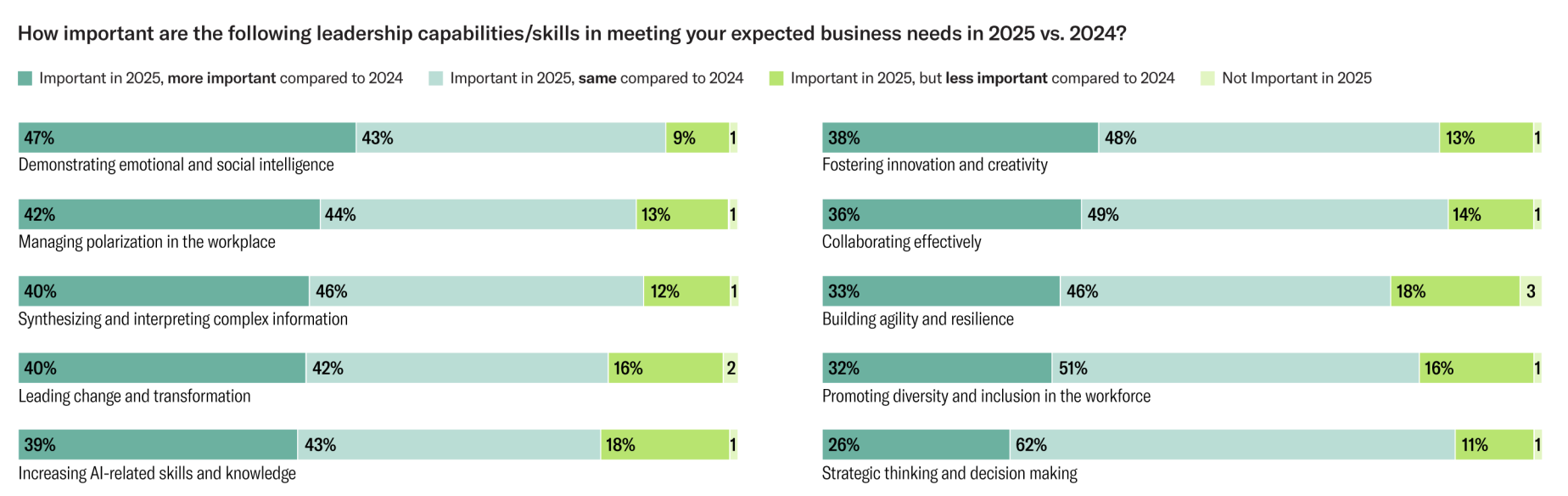
According to a 2025 Harvard Business Impact report, emotional and social intelligence remain at the top of the leadership capabilities list when it comes to meeting current and expected business needs. Almost half of their respondents believe that social and emotional intelligence is even more critical than it was in 2024. Emotional intelligence and human empathy also comes in at the top.
In practise, this shows up as:
Reading the room by picking up concerns and addressing them with empathy
Listening to understand, not to respond,
Being able to understand and appropriately react to people’s emotions/fears/concerns and feelings,
The ability to listen, communicate authentically and respond compassionately.
Notably, these are capabilities AI cannot replicate which All of which are notably skills that machines do not have.
2. Authenticity
A report we did based on a recent panel discussion revealed the need for leaders to be authentic. While authenticity has become a highly sought after skill it is not as simple as ‘just be yourself’.
In many workplace cultures, openness can come with a high risk, especially for people who may not feel comfortable to bring their whole selves to work.
For leaders, being authentic may look like:
Holding boundaries by being consistent so your team knows what you stand for and what you will not tolerate,
Admitting mistakes and correcting them without it escalating.
If you want authenticity to land well, make sure you’re giving your team a safe space to discuss the things that really matter to them. Done well, authenticity can have a positive impact on commercial success and team morale – but boundaries need to be clear for both the leader and the team.
3. Networking
Let’s face it. Whether you’re an introverted or extroverted leader, learning to network is highly personal. And, not everyone likes it. But networking has proven to be a skill senior leaders at the top of their game are best at. Better yet, introverted leaders are just as good – if not better networkers than their extroverted counterparts.
If networking feels uncomfortable, try reframing it as professional socialising. The trick is to not use events in order to collect business cards. Rather, use them to get to know the people in the room and don’t forget to follow-up.
Not sure how to get started? Check out our online networking course for senior leaders. Designed specifically for senior executives we cut to the chase and share our playbook in just fourteen minutes.
Technical skills every leader needs to know in 2026
Perhaps unsurprisingly, AI related skills dominate this list. But, reassuringly – so does critical thinking.
Critical thinking
Critical thinking skills are a must-have in the age of technology advancements. With AI finally leading the top of everyone’s boardroom agenda this is perhaps unsurprising.
A study suggests that 73% of talent acquisition leaders rank critical thinking as their number one recruiting priority – while AI skills rank fifth. Why? AI skills can be learned in weeks. Critical thinking? That takes years. If that stat gives you a sense of relief, you’re certainly not alone.
2. AI governance
While leaders do not need to be technical experts, they do need to know how to set guardrails. At board level, the question is not whether you’re using AI, but whether you’re using it safely and can identify your risk exposure.
At minimum, leaders need to ensure the following are in place:
Documentation process: Creating a documentation workflow to identify whats being processed via AI including prompt engineering and output in order to protect your brand IP,
Human in the loop: Making sure there is human oversight to review, override or stop processes that are no longer effective,
Accountability: Identify and document who fact-checks, owns the output and signs off AI output,
AI Champion: Someone who creates a space for teams to experiment with AI and reports back on findings and on-going discussions.
3. Data storytelling
Understanding what the data says and knowing what to do it makes a good data storyteller great. At leadership level, this means knowing how to align the creative direction with commercial impact.
Strong data storytelling looks like:
Understanding what the data is suggesting, and knowing what to take out from it,
Knowing what parts to take an experimental approach, and what part to double down on,
Being clear on what you recommend based on the data, and what you’re deprioritising as well as the trade offs.
What strong leadership teams look like in 2026
In 2026, leadership is less about keeping up with every new tool and more about critical thinking. Technology has created a nuance where efficiency at scale is easy to execute which leaves room to crave for a more strategic approach.
If you’re sense checking what good looks like at board and executive level or want a clearer plan for developing these capabilities across your leadership team, The L Factor Ltd can help. We work with senior leaders to strengthen leadership teams, decision making and influence through mentoring and practical development that fits into the modern world of work. Get in touch today.
Frequently Asked Questions
What are the top skills leaders should know in 2026?
Leaders should lean on a mix of soft skills and technical skills to be the bridge between technological advancement and people-centred teams.
Why is critical thinking more important than AI skills?
AI tools can be learned quickly. Critical thinking takes time and protects decision quality. It helps leaders spot weak assumptions, poor evidence, and overconfidence, including from AI outputs.
What does good AI governance look like at leadership level?
Clear boundaries on data use, accountability for outputs, human oversight, transparency on where AI is used, and agreed thresholds for risk and escalation.
What is the difference between networking and “professional socialising”?
Professional socialising reframes networking as relationship-building with intent. It is about learning, exchanging value, and staying connected to opportunities, rather than self-promotion.
Are introverts at a disadvantage when it comes to networking?
No. Introverted leaders often do well because they focus on depth over volume. Consistent, thoughtful follow-up usually beats a high volume approach.
Are there any useful networking courses I can take?
Yes. If you want something practical and built for real world leadership situations (hybrid work, senior stakeholders, and high trust conversations), Our networking course is designed to help you network with intention. It covers how to approach relationship building without it feeling transactional, how to follow up in a way that builds momentum, and how to turn everyday conversations into long term opportunities.